Procurement Software Trends in 2026: What to Expect
Read More →

×
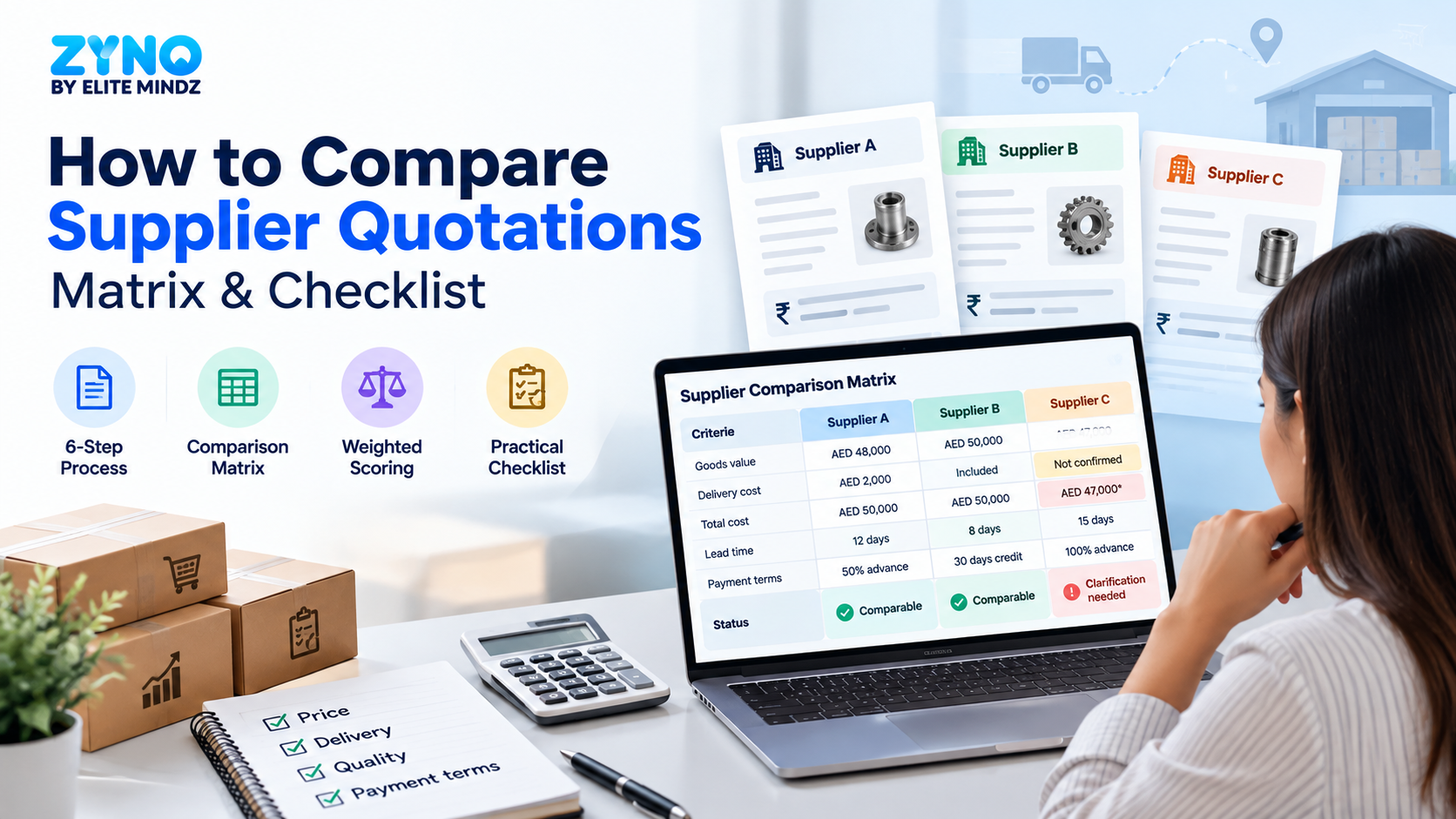
Supplier quotation comparison is the process of evaluating supplier offers against the same specifications, quantities, total costs, delivery timelines, quality requirements, and payment terms to select the most suitable supplier. A comparison matrix helps identify hidden costs, missing information, and commercial risks before approval. The lowest-priced quotation is not always the best choice; the winning supplier should meet mandatory requirements and offer the best overall value.
Businesses using ZYNO Books cut accounting time by 70% and stay 100% ZATCA-compliant — automatically.
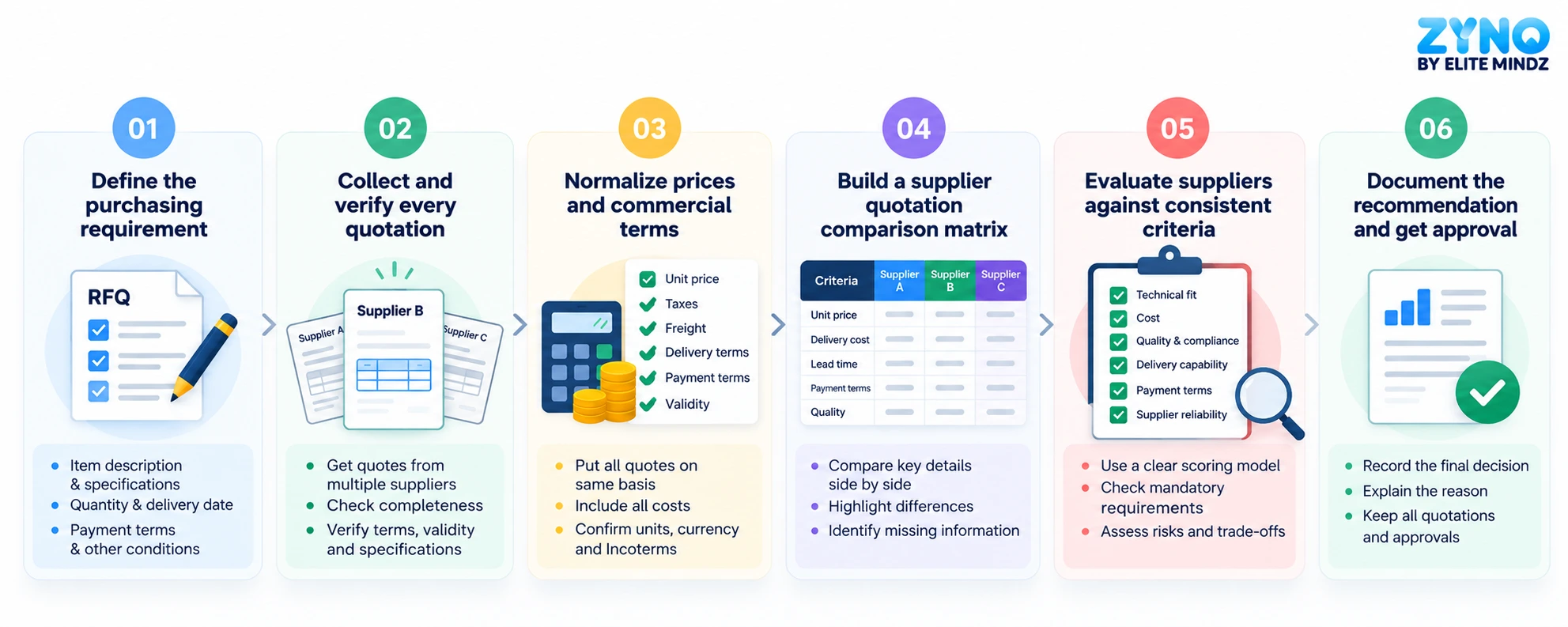
To compare supplier quotations, make sure every supplier has quoted the same requirement, put prices and terms on a common basis, record them side by side in a comparison matrix, score each offer against fixed criteria, and document why you chose the winner. The lowest price wins only if the offer is also complete, compliant and deliverable.
The 6 steps:
Two suppliers can quote different prices for what looks like the same product. One price may exclude delivery. Another may assume a larger minimum order, a different grade or a shorter validity. Compare the headline numbers and you are comparing unlike offers.
This guide shows you how to compare supplier quotations step by step, with a worked example, a weighted scoring model, a checklist and answers to common questions. It also explains when Excel is enough and when quotation comparison software starts to make sense.

Supplier quotation comparison is the process of reviewing offers from several suppliers for the same purchasing requirement, on the same basis, before you select one.
A good comparison puts these details in one place:
The resulting document goes by many names: supplier quotation comparison matrix, comparative statement of quotations, quotation comparison sheet or bid comparison table. Vendor comparison and supplier comparison mean the same thing here, so a vendor comparison matrix works exactly the same way. The purpose is the same in every case: make offers easy to compare, expose gaps that need clarification and support a documented purchasing decision.
A matrix does not pick the winner for you. It gives your team a consistent basis for making, and explaining, that choice.
A procurement comparison matrix replaces scattered emails, personal spreadsheets and headline prices with one structured view. It helps most when several suppliers quote for the same materials, equipment, components, services or recurring purchases.
It prevents misleading price comparisons. A supplier quoting AED 480 per unit looks cheaper than one quoting AED 520, until you see that the first excludes packaging and delivery or uses a different specification.
It exposes missing information. If a supplier has not confirmed delivery dates, warranty or payment terms, the matrix shows the gap before you award the order.
It improves supplier evaluation. Price, quality, delivery capability, compliance and payment terms are assessed together instead of one at a time.
It supports approvals and accountability. Reviewers see the quotations, the criteria and the reasoning behind the recommendation.
It standardizes decisions. When every buyer uses the same method, similar purchases are evaluated the same way across departments and locations.
Start with a clear requirement or request for quotation (RFQ). Include the item description, specification, quantity, unit, delivery location, required delivery date and commercial conditions such as payment terms and warranty.
Send the same requirement to every supplier. If the specification changes, send the revision to all of them and ask each to confirm that their quotation reflects it.
Why it matters: you cannot compare suppliers fairly if they priced different requirements.
For each quotation, record the supplier name, quotation reference, issue date, validity period and currency. Check that it answers the correct RFQ revision and that nothing is missing.
Flag anything incomplete:
Ask suppliers to clarify before you compare. Keep the original quotations so every matrix entry can be checked against its source.
Normalizing means putting every offer on the same footing before you decide which is cheapest. Check these five areas for each supplier.
Specifications. Confirm each supplier quoted the required grade, dimensions, model, capacity or service scope. Record deviations. Do not treat an alternative as equivalent until the right technical or quality person has reviewed it.
Quantities and units. A quotation for 100 boxes of 10 components is not comparable with one for 100 individual components. Check the quantity, unit of measure, pack size, MOQ and any volume discounts. Convert to a common unit where needed.
What the price includes. Check for packaging, installation, tooling, inspection, delivery, insurance and documentation. Do not assume something is included because it is not listed. Ask. Adding these costs to the quoted price gives the landed cost, the true cost of getting the goods to your door.
Currency, tax and delivery terms. Record the currency and the exchange rate date. Note whether prices include or exclude tax. In the UAE, for example, 5% VAT applies to most goods; compare prices on one consistent basis (usually excluding recoverable input VAT) and confirm the treatment with your finance team. For international sourcing, Incoterms and the named delivery point decide who pays for freight, insurance and duties.
Validity and delivery commitments. Record when each quotation expires and what delivery lead time and capacity the supplier has committed to.
Where the information is available, calculate a comparable cost the same way for every supplier:
Comparable cost = quoted goods value + applicable additional costs − applicable discounts
This is a simplified formula. Adjust it to your tax treatment and to the costs your organization includes in a comparison.
One rule matters more than the formula: an unknown cost is not zero. If a supplier has not confirmed freight, mark it as outstanding. Do not enter 0 and let that supplier look cheaper than it is.
Create one column per supplier and one row per evaluation criterion. A practical matrix includes:
For larger purchases, add one row per line item as well as a summary per supplier. Otherwise a supplier's missing item can hide inside an apparently lower total.
Once the offers are comparable, assess each supplier on the same questions:
Treat mandatory requirements as pass or fail. A low price should never compensate for a safety, technical or regulatory requirement the supplier cannot meet. For purchases with real trade-offs, use weighted scoring (explained below).
Record the preferred supplier, the reasons, any unresolved issues and the approvals required. Keep the original quotations, clarification emails, the matrix, the calculations and the decision notes together.
If the chosen supplier is not the lowest bidder, say why. The reason might be technical compliance, a more complete quotation, a delivery commitment, stronger quality controls or better overall terms. The goal is a decision that traces back to the requirements and the evidence, not a justification for a choice already made.
Want to run this process without chasing spreadsheets and email threads? Book a ZYNO demo and see how RFQs, quotation comparison and supplier selection work in one place.
Compare supplier offers side by side, identify missing costs, and make informed purchasing decisions with a structured procurement workflow.
Request a Free Demo Explore ZYNO ProcurementA manufacturing company is buying 100 components from three suppliers. All figures are illustrative only. They demonstrate the method and do not represent market prices or real suppliers. Assume all three quoted the same approved specification and quantity.
| Evaluation criterion | Supplier A | Supplier B | Supplier C |
|---|---|---|---|
| Quoted unit price | AED 480 | AED 500 | AED 470 |
| Goods value (100 units) | AED 48,000 | AED 50,000 | AED 47,000 |
| Stated delivery charge | AED 2,000 | Included | Not confirmed |
| Goods value + stated delivery | AED 50,000 | AED 50,000 | AED 47,000* |
| Meets required specification | Yes | Yes | Yes |
| Delivery lead time | 12 days | 8 days | 15 days |
| Payment terms | 50% advance | 30 days credit | 100% advance |
| Quotation validity | 15 days | 30 days | 10 days |
| Outstanding information | None | None | Delivery charge |
| Status | Comparable | Comparable | Clarification needed |
Supplier C's AED 47,000 excludes the unconfirmed delivery charge. It is not a complete comparable cost.

Supplier A costs AED 50,000 before taxes and any other charges, meets the specification and needs half the payment in advance.
Supplier B also totals AED 50,000, delivers fastest (8 days) and offers 30-day credit. Confirm the delivery commitment in writing.
Supplier C has the lowest goods value, but its delivery charge is unknown. It cannot be called the cheapest until that gap is closed. It also asks for full advance payment and the shortest validity.
The right next step is to ask Supplier C to confirm its delivery charge, then evaluate the complete offers. The table alone does not decide the winner. It shows what you still need to know.
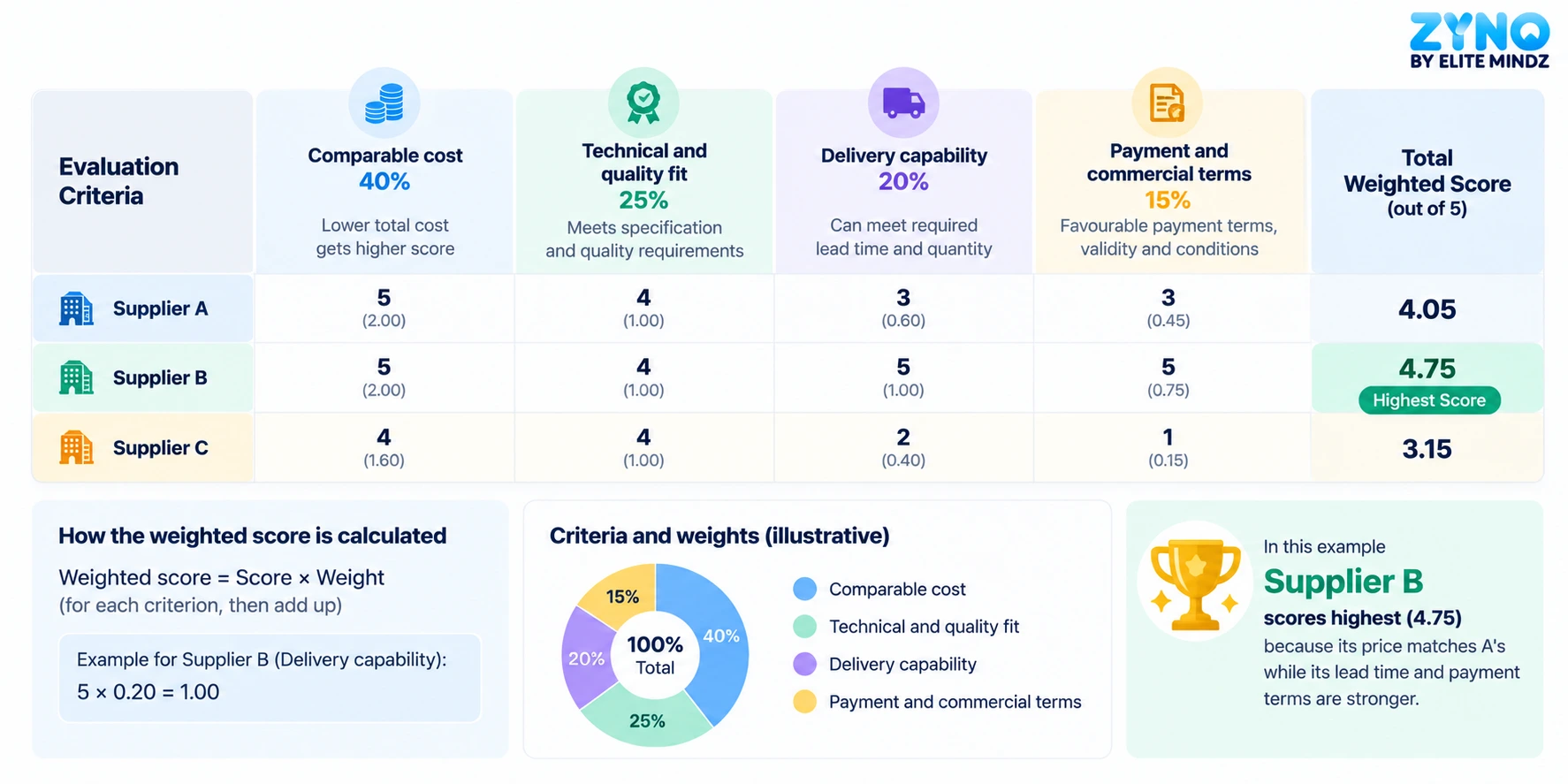
When price is only one of several important factors, a weighted supplier evaluation matrix keeps the comparison consistent. Assign each criterion a weight based on its importance, score every supplier on the same scale, multiply, and add up.
Continuing the example, suppose Supplier C confirms a delivery charge of AED 3,500, making its comparable cost AED 50,500. Score each supplier from 1 (poor) to 5 (excellent):
| Criterion | Weight | Supplier A | Supplier B | Supplier C |
|---|---|---|---|---|
| Comparable cost | 40% | 5 | 5 | 4 |
| Technical and quality fit | 25% | 4 | 4 | 4 |
| Delivery capability | 20% | 3 | 5 | 2 |
| Payment and commercial terms | 15% | 3 | 5 | 1 |
| Weighted score | 100% | 4.05 | 4.75 | 3.15 |
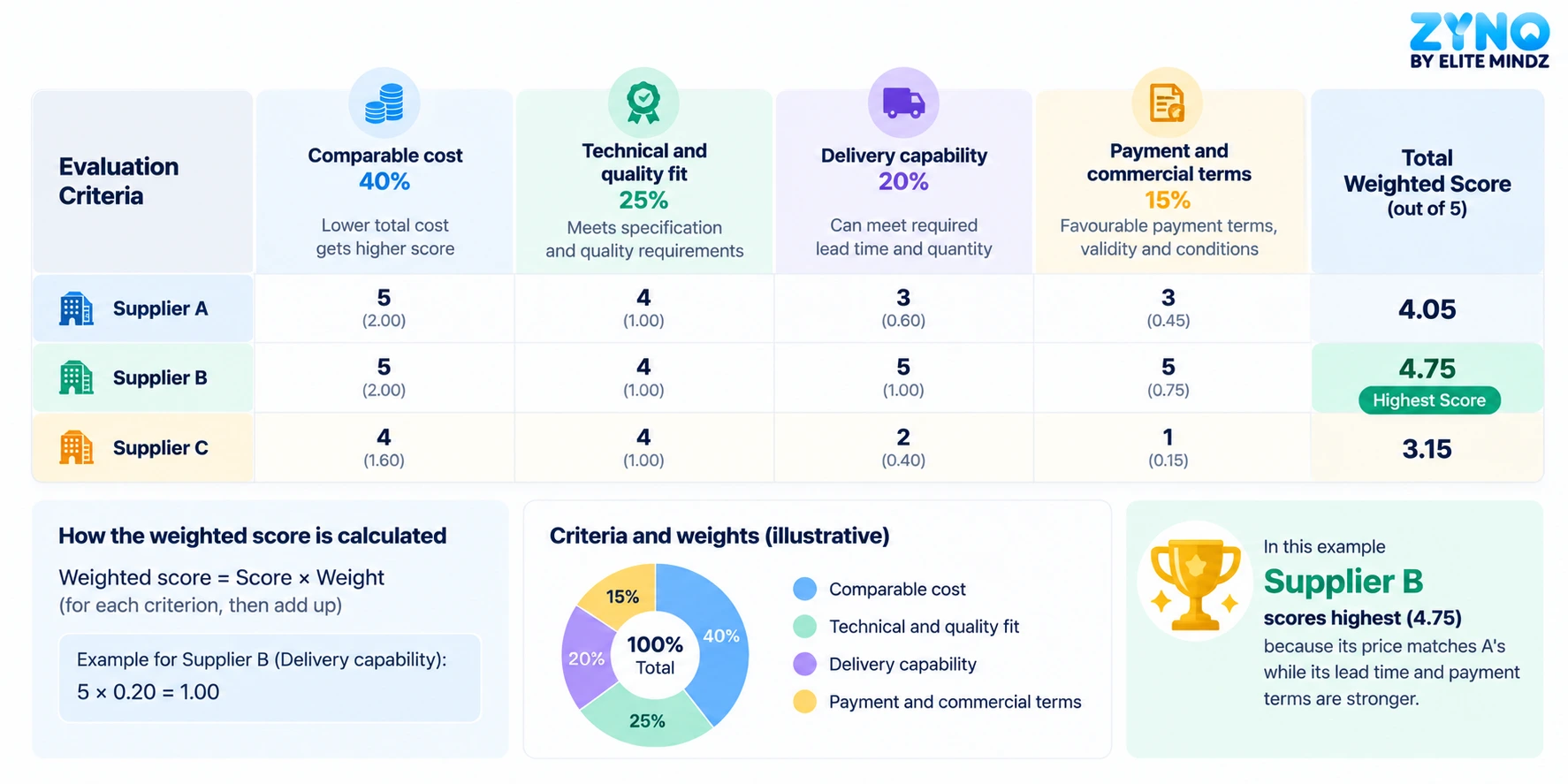
For Supplier B: (5 × 0.40) + (4 × 0.25) + (5 × 0.20) + (5 × 0.15) = 4.75. In this illustration Supplier B scores highest because its price matches A's while its lead time and payment terms are stronger.

Three rules keep scoring honest:
For simple purchases, a pass-or-fail check and a comparable cost table is often enough.
Use this quotation comparison template to line up supplier prices in Excel or Google Sheets. Copy the two tables below into a sheet, add or remove supplier columns as needed, and fill in one quotation at a time.
Part 1: Line-item prices
| Item | Specification | Qty | Unit | Supplier A unit price | Supplier B unit price | Supplier C unit price | Notes |
|---|---|---|---|---|---|---|---|
Part 2: Comparable cost and terms
| Criterion | Supplier A | Supplier B | Supplier C |
|---|---|---|---|
| Goods value (Qty × unit price, all items) | |||
| Delivery or freight | |||
| Packaging, installation and other charges | |||
| Discounts | |||
| Tax treatment (included or excluded) | |||
| Comparable cost | |||
| Delivery lead time | |||
| Payment terms | |||
| Quotation validity | |||
| MOQ | |||
| Specification deviations | |||
| Missing or unconfirmed information | |||
| Weighted score (optional) | |||
| Decision and reason |
Four tips for using it well:
For significant or long-term purchases, the cheapest quotation is not always the cheapest decision. Total cost of ownership (TCO) adds the costs that follow the purchase:
Include only costs you can support with evidence, and state your assumptions. A machine with a higher price may cost less over its life if documented operating and maintenance costs are lower. For routine purchases, a full TCO model is unnecessary. Make the current quotations comparable and note any material cost differences.
Organize supplier quotations, review commercial terms, and document supplier selection. See how ZYNO Procurement can support your quotation workflow.
Request a Free Demo Explore ZYNO ProcurementAn Excel quotation comparison sheet is flexible, familiar and often enough for a one-off purchase with a few suppliers and line items. It starts to strain when RFQs recur, several people are involved, and quotations live in separate files and email threads.
| Situation | Excel or manual sheet | Quotation comparison software |
|---|---|---|
| One-off comparison, few suppliers | Usually sufficient | Often unnecessary |
| Custom comparison fields | Very flexible | Depends on the product |
| Repeated RFQs | Needs manual organization | Look for RFQ management features |
| Comparing many supplier offers | Possible with a well-kept matrix | Look for built-in comparison |
| Keeping decisions and records together | Depends on file discipline | Look for workflow and record keeping |
| Link to wider purchasing process | Usually separate tools | Depends on modules and integrations |
Software does not replace clear requirements or good judgment. Before choosing a system, check that it fits your real quotation formats, approval process and reporting needs.
ZYNO Procurement by Elitemindz includes capabilities that map directly to the steps above:
The best way to judge any system is to test it with your own purchase. In a demo, ask to see how your team would:
Book a ZYNO demo to walk through these steps with your own purchasing scenario. For supplier-related workflows, see ZYNO Vendor Management.
Comparing quotations is one step in a longer buying process. For the stages before and after it, read our guides on purchase requisition vs purchase order and the procure-to-pay process.
Use this checklist before you recommend a supplier.
Requirement and scope
Quotation completeness
Commercial comparison
Supplier evaluation
Decision and documentation
Confirm that all suppliers quoted the same specification, quantity and scope. Normalize units, currency, tax treatment and charges. Compare price, quality, delivery, payment terms and supplier suitability in a comparison matrix, resolve missing information, and document the reason for your final choice.
Put the two quotations side by side and check them in this order:
With only two quotations, differences hide easily behind the headline price. The cheaper-looking offer can cost more once delivery and payment terms are counted. Many organizations also require a minimum number of quotations for larger purchases, so check your own purchasing policy.
A good vendor comparison matrix has the vendors as columns and the decision criteria as rows, with a weight for each criterion and a score for each vendor. Common criteria are comparable cost, specification fit, quality and compliance, delivery capability, payment and commercial terms, and supplier reliability. Treat mandatory requirements as pass or fail, and make the weights add up to 100%. The weighted scoring example in this guide shows the full calculation.
Attach the original quotations to the statement so reviewers can check every figure.
Yes. The copy-and-use template in this guide has a line-item table and a table for comparable cost and commercial terms. Paste both into Excel or Google Sheets, and add the weighted scoring table from the worked example if you need to score suppliers as well.
A procurement comparison matrix is a table that places supplier offers side by side against the same criteria. It usually covers specifications, quantities, prices, commercial terms, delivery, quality requirements, deviations and the evaluation outcome.
At minimum: item description, unit, quantity, each supplier's unit price and total, relevant charges, delivery lead time, payment terms, validity and any missing information. Add quality and compliance criteria, scores and the decision rationale where relevant.
The terms usually describe similar documents. A comparative statement of quotations presents supplier offers side by side, with item-level prices and key commercial terms. The exact format depends on the organization's purchasing process.
No. First confirm the supplier meets mandatory requirements and the quotation is complete. A higher-priced offer may be the better choice because of its specification, delivery commitment, quality provisions or overall terms. A low quotation should still get a fair evaluation, not an automatic rejection.
Create one column per supplier and one row per item or criterion. Record quantities, unit prices, totals, delivery charges, payment terms and other relevant details. Use formulas for the arithmetic, highlight missing information, and check the results against the original quotations before recommending a supplier.
Excel works for occasional, simple comparisons. Consider software when RFQs recur often, several people are involved, or you need a more structured way to manage quotation comparison and supplier selection. Check the actual capabilities of any system before you decide.
An RFQ communicates the requirement and asks suppliers to submit offers. Quotation comparison happens after the offers arrive: the team reviews the responses against the requirement and decides which supplier is most suitable.
A reliable supplier quotation comparison starts with a clear requirement and ends with a documented, evidence-based decision. Use the same scope for every supplier, normalize the commercial terms, record what is missing and compare offers against consistent criteria. Look past the headline price whenever delivery, quality, compliance or hidden costs affect the outcome.
A well-kept comparison matrix makes those differences visible and helps your team explain why a supplier was chosen. For recurring RFQs, quotation comparison software can keep the whole process organized in one place.
Ready to move your supplier quotations out of spreadsheets and inboxes? Book a ZYNO demo and see RFQ management, quotation comparison and supplier selection in action.
See how RFQ management, quotation comparison, and supplier selection can fit into your purchasing process.
Request a Free Demo Explore ZYNO Procurement
Procurement Software Trends in 2026: What to Expect
Read More →
Why E-Procurement Outperforms Traditional ERP in Modern Procurement
Read More →
Top Procurement Software in India: 12 Best Options for 2026
Read More →
Best Procurement Software Companies in Kuwait (2025)
Read More →
5 Best Procurement Software in Africa for Enterprises & SMEs (2026 Guide)
Read More →
Best Procurement Software in Nigeria 2026 | Top 5 Picks
Read More →
Best Procurement Software Providers in USA (2025): How AI is Transforming the Future
Read More →
10 Best Procurement Software Providers in Thailand for Streamlined Supply Chain Management
Read More →
Top 10 Cloud-Based Procurement Solutions in Portugal for Businesses in 2025
Read More →
Top 10 Procurement Software Providers in Switzerland 2026: Streamlining Sourcing and Supplier Management
Read More →
What Makes ZYNO Procurement Different from Other Oil & Gas Procurement Software
Read More →
The Digital Transformation of Logistics Procurement in the Middle East
Read More →
A Step by Step Guide to Procurement Management Software for Modern Enterprises
Read More →
Sourcing and Procurement: What is the Difference and Why It Matters
Read More →Difference Between Procurement and Supply Chain Management
Read More →
What Is Procurement Software and Why Do Modern Businesses Need It?
Read More →
Best Procurement Management Software to Automate ERP Process
Read More →
Direct vs Indirect Procurement: Key Differences, Examples & Uses (2026)
Read More →
Smart procurement strategies for cost optimization & risk management
Read More →
What Is Procurement? Everything You Need to Know (Types, Process & SAP)
Read More →Beyond Cost-Cutting: How Procurement Drives Margin Expansion in 2026
Read More →
Direct Procurement: Process, Examples, and When to Use It
Read More →
What Are the 5 Types of E-Procurement? A Complete Guide for Businesses
Read More →
Which Procurement Management Software Is Best? Top Tools Compared for 2026
Read More →
Top 8 Coupa Alternatives to Explore in 2026
Read More →
Looking to Replace Coupa? Discover the Best Alternatives Like ZYNO Procurement
Read More →
How Does Procurement Software Work? A Complete Guide
Read More →
ZYNO Procurement vs Coupa: Best Procurement Software Comparison for Mid-Market Teams
Read More →
10 Best SAP Ariba Alternatives and Competitors in 2026
Read More →
ZYNO Procurement vs SAP Ariba: Which Solution Is More User-Friendly?
Read More →
AI-Powered Procurement Management Software for Fast, Connected, and Visible Workflows in Dubai
Read More →
What is Vendor Management? Complete Guide to Vendor Management Software, Systems, and Processes
Read More →
Best Procurement Management Software In Kenya
Read More →
6 SAP Ariba Alternatives for Mid-Market Businesses in 2026
Read More →
Top E-Procurement Solutions for B2B Organizations (2026)
Read More →
Quotation Format: Free Templates + Complete Guide (2026)
Read More →
Cost Control Software: Features, Benefits & Performance Guide for 2026
Read More →
Procurement Workflow: Steps, Stages, and Real Examples
Read More →
Top 10 Zycus Alternatives for Procurement Teams in 2026
Read More →
Best Precoro Alternative for Purchase Requisition and Procurement
Read More →
Top AI Procurement Tools in 2026
Read More →
Best Tools for Supplier Risk Management
Read More →
FEFO vs FIFO vs LIFO: Differences, Benefits & Which Inventory Method Is Best?
Read More →
AI Procurement Software: Features, Benefits, Use Cases & How to Choose
Read More →
Best AI Tools for Supply Chain Procurement
Read More →
Procurement Risk Management
Read More →
Still Using Excel for Procurement? Read This Before It's Too Late
Read More →
Best RFP Software in 2026: Top Tools Compared for Faster Proposal Responses
Read More →
What Is Procure-to-Pay (P2P)? A Complete Guide
Read More →
Complete Procurement Workflow Guide for Modern Businesses
Read More →
Complete Guide to E-Procurement Solutions for B2B Organizations
Read More →
Cost Control Software Comparison Guide: Features, Pricing & Benefits
Read More →
Purchase Order Tracking: How to Manage Every PO Without the Chaos
Read More →
Inventory Management: What It Is, How It Works and Why It Matters
Read More →
Top 10 Procurement Software Tools for Purchasing Automation in 2026
Read More →
Agentic AI Procurement Platforms and the Future of Strategic Sourcing
Read More →
AI Spend Analytics Software for Procurement Leaders
Read More →
From Prompt to Procurement: How AI Is Transforming Enterprise Purchasing
Read More →
ZYNO Procurement vs IBM Procure-to-Pay Automation
Read More →
ZYNO Procurement vs Infor Nexus: Which Procure-to-Pay Platform Fits Your Team?
Read More →
AI-Powered Procurement Software in 2026: Top 6 Platforms That Actually Deliver ROI
Read More →
Contract Management Software Buyer's Guide: Features, Costs & Top Picks
Read More →
Top 10 Procure to Pay Software Companies in India 2026
Read More →
10 Best Vendor Management Software in India (2026): Features, Benefits & Comparison
Read More →
How Machine Learning and AI Are Transforming Procurement: A Strategic Overview
Read More →
What Is Procurement Software for GP? Features, Benefits and Best Solutions for Businesses
Read More →
What Procurement Software Do Mid-Market Companies Use Instead of SAP Ariba or Coupa?
Read More →
Prompt-Based Procurement Software for Kenyan Businesses
Read More →
Project Management Software: A Complete Guide to Streamline Business Operations and Procurement Processes
Read More →
SAP Ariba vs ZYNO Procurement: Complete Feature Comparison (2026)
Read More →
Coupa vs SAP Ariba vs ZYNO: Which Procurement Platform Wins for Fast-Growing Teams?
Read More →
How AI Procurement Software Is Transforming Purchase Requisition and Supplier Management in 2026
Read More →
Purchase Request Management: A Complete Guide for Modern Procurement Teams
Read More →
The Top 3 Best Practices for Effective Purchase Request Management
Read More →
What Is Purchase Order Automation? How to Automate Purchase Order Processing
Read More →
5 Common Purchase Request Mistakes and How to Avoid Them
Read More →
What is Supplier Relationship Management in Procurement? A Complete Guide
Read More →
What is Strategic Vendor Management? A Complete Guide for Modern Procurement
Read More →
What Are Inventory Control Methods? Complete Guide to Types, Techniques, Systems, & Benefits
Read More →
Inventory Audit Checklist: Steps, Process & Best Practices
Read More →
Warehouse Inventory Management: Best Practices for 2026
Read More →
Treasury Management System (TMS): A Complete Guide for Modern Corporates
Read More →
What is Portfolio Management Services (PMS) and What Are Its Benefits?
Read More →
Generative AI Procurement Software Solution: The Future of Intelligent Procurement
Read More →
Top Contract Management Software Companies in Ethiopia: Features, Benefits & Best Procurement Solutions
Read More →
AI Procurement Software: Complete Guide to Intelligent, Generative AI & Machine Learning Procurement Solutions
Read More →
Top SAP alternatives for small, midsize, and enterprise businesses
Read More →
Best RFP Software in 2026: Top Solutions for Smarter Procurement and Proposal Management
Read More →
GST on Purchase: Complete Guide to GST on Purchases in India
Read More →
Procurement Software in the UAE: How to Choose the Right Solution
Read More →
Supply Chain Procurement: Everything You Need to Know
Read More →
Top 10 Oracle Procurement Alternatives for Businesses in 2026
Read More →
Quotation Software vs Excel: Which Is Better for Businesses in 2026?
Read More →
Contract Management Software Buyer's Guide: Features, Pricing & How to Choose
Read More →
How to Identify the Right Vendor: 10 Simple Steps
Read More →
Top 10 Automated PO Generation Tools in 2026: Best Purchase Order Software with AI Capabilities
Read More →
How to Generate a PO Automatically in SAP: Step-by-Step Guide
Read More →
What Is the Best Budget-Friendly Procurement Software With Vendor Onboarding for Indian SMEs?
Read More →
How to Generate a PO Automatically in SAP: Step-by-Step Guide
Read More →
How to Solve Invoice Mismatches: 10 Real Ways to Fix Invoice Discrepancies
Read More →
Top 10 Vendor Onboarding Tools for Businesses in 2026: Features, Process & How to Choose
Read More →
Vendor Comparison & Supplier Intelligence: How AI Helps Businesses Choose the Right Vendor
Read More →
How to Choose the Right Procurement Management Software in 2026 (Complete Buyer's Guide)
Read More →
How to Reduce Procurement Costs: 18 Practical Strategies That Actually Work
Read More →
How to Choose the Right Procurement Management Software in 2026 (Complete Buyer's Guide)
Read More →
How to Calculate Procurement Software ROI: Formula, Example & Calculator
Read More →
Procurement Software Evaluation Checklist: 35 Criteria for Choosing the Right Platform
Read More →
How Businesses Can Improve Vendor Performance and Manage Supplier Risk
Read More →
Procure-to-Pay Process: Steps, Challenges & How to Automate It
Read More →
Purchase Requisition vs Purchase Order: What’s the Difference?
Read More →
10 Source-to-Pay Software Platforms to Consider in 2026
Read More →
Supplier Management Software Buying Guide: How to Choose the Right Platform
Read More →
Procurement Automation Guide: How It Works, What to Automate & How to Implement It
Read More →
Procurement Software Features: 12 Must-Have Capabilities to Look For
Read More →
Best E-Procurement Software in 2026: Top Electronic Procurement Systems for Modern Businesses
Read More →
AI in Vendor Management: Complete Guide to Automated Supplier Scoring and Supply Chain Risk Analysis
Read More →
Procurement Software vs ERP: What's the Difference and Which Do You Need?
Read More →
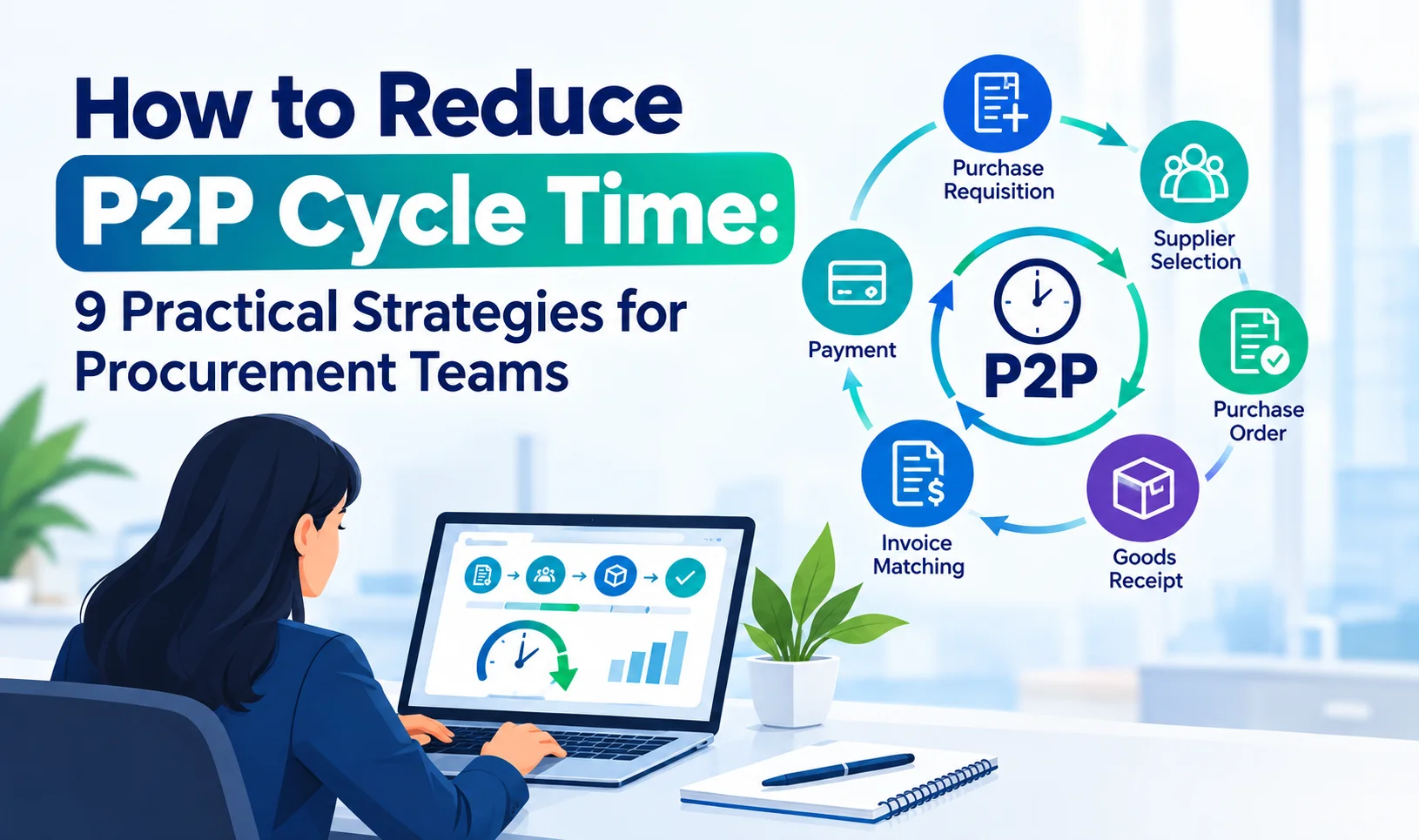
How to Reduce P2P Cycle Time: 9 Practical Strategies for Procurement Teams
Read More →
Procurement Software for Oil & Gas Companies in UAE and Saudi Arabia
Read More →
10 Vendor Onboarding Best Practices Every Business Should Follow (2026)
Read More →
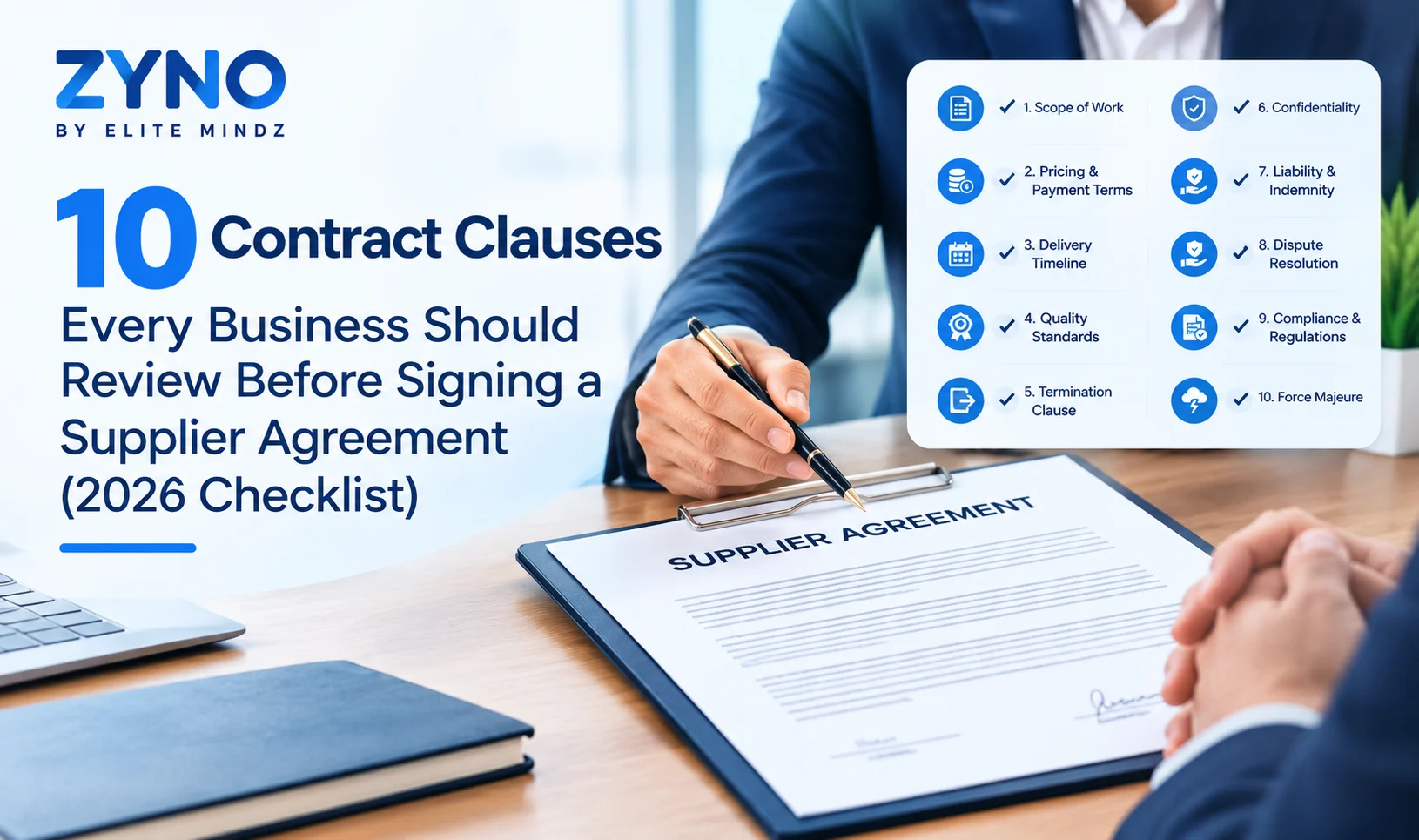
10 Contract Clauses Every Business Should Review Before Signing a Supplier Agreement (2026 Checklist)
Read More →
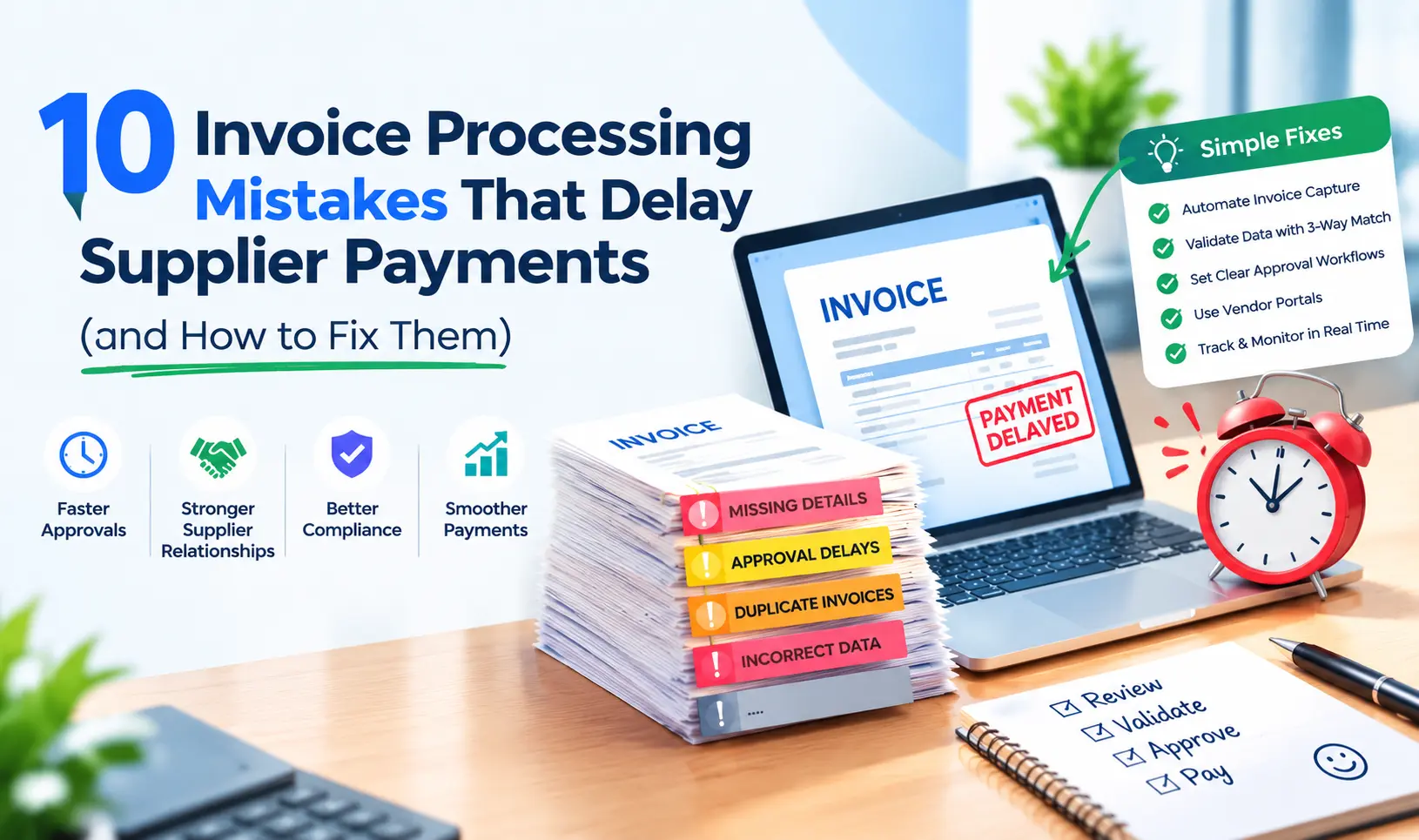
10 Invoice Processing Mistakes That Delay Supplier Payments (and How to Fix Them)
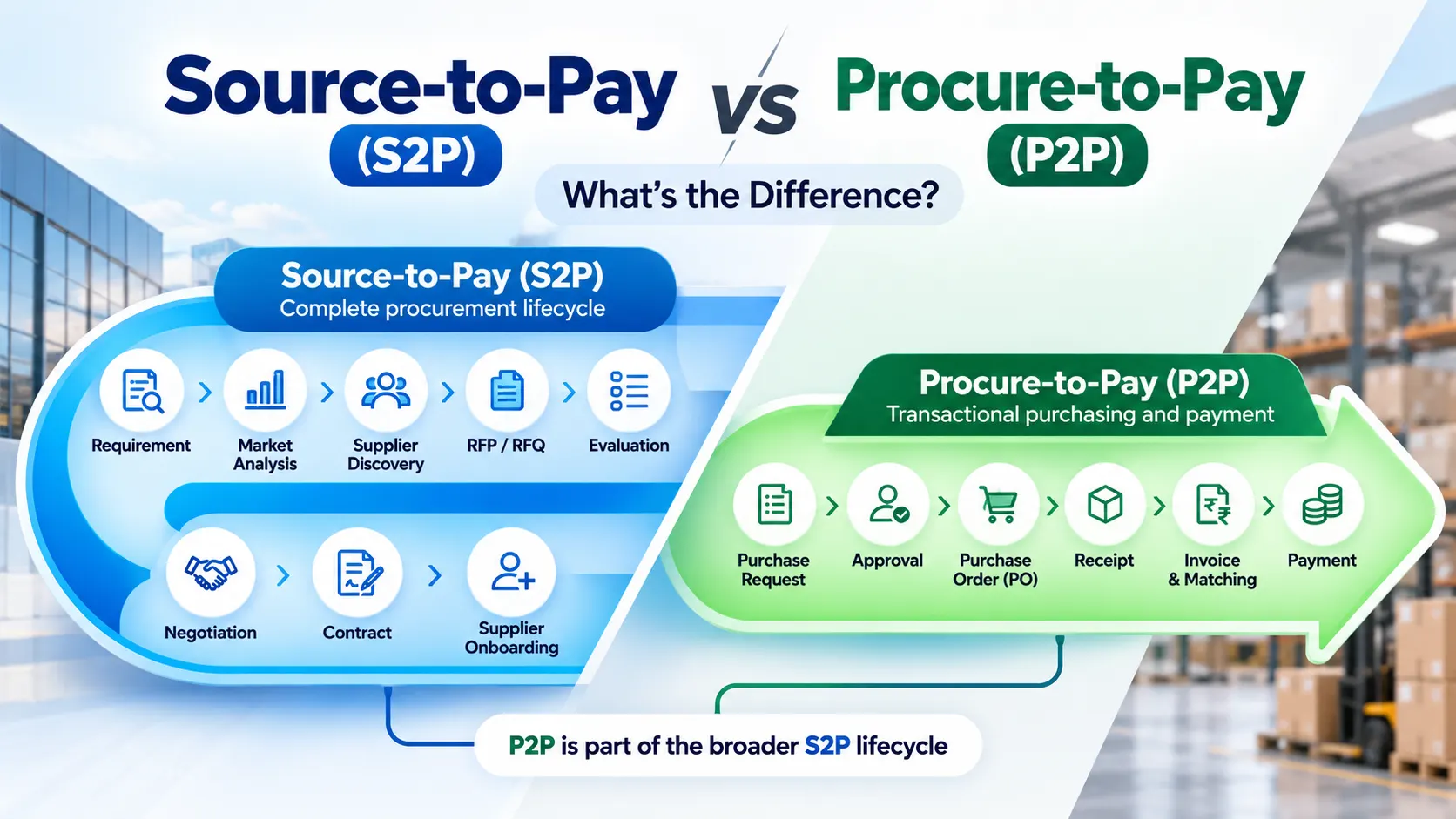
Read More →Source-to-Pay vs Procure-to-Pay: Key Differences, Processes & Software Guide
Read More →
Procurement Challenges: 15 Common Problems & How to Solve Them
Read More →
Supplier Evaluation Criteria: 10 Factors Every Procurement Team Should Assess
Read More →
What Is Strategic Sourcing? Process, Benefits & Best Practices
Read More →
Tail Spend Analysis: How to Identify, Measure and Optimize Fragmented Spend
Read More →
Which Prompt-Based ERP Supports Procurement Automation and Analytics?
Read More →
How to Stop Employees from Making Purchases Without Approval in the UAE
Read More →
How to Build a Purchase Approval Workflow for Manufacturing Companies
Read More →
Best Procurement Software for Sheet Metal Fabrication Companies
Read More →
10 Best Procurement Software for Manufacturing Companies in 2026
Read More →
How to Compare Supplier Quotations and Choose the Right Supplier
Read More →
10 Best Contract Automation Software Tools for 2026
Read More →
Best Procurement Software for CNC Machining Companies: 8 Options Compared
Read More →Partner with ZYNO by Elite Mindz to revolutionize how your business works. Fill out the form, and we’ll reach out with AI-powered solutions made just for you.
We use browser cookies to ensure you get the best experience on our website. Learn more
The form was submitted successfully!