Procurement Software Trends in 2026: What to Expect
Read More →

×
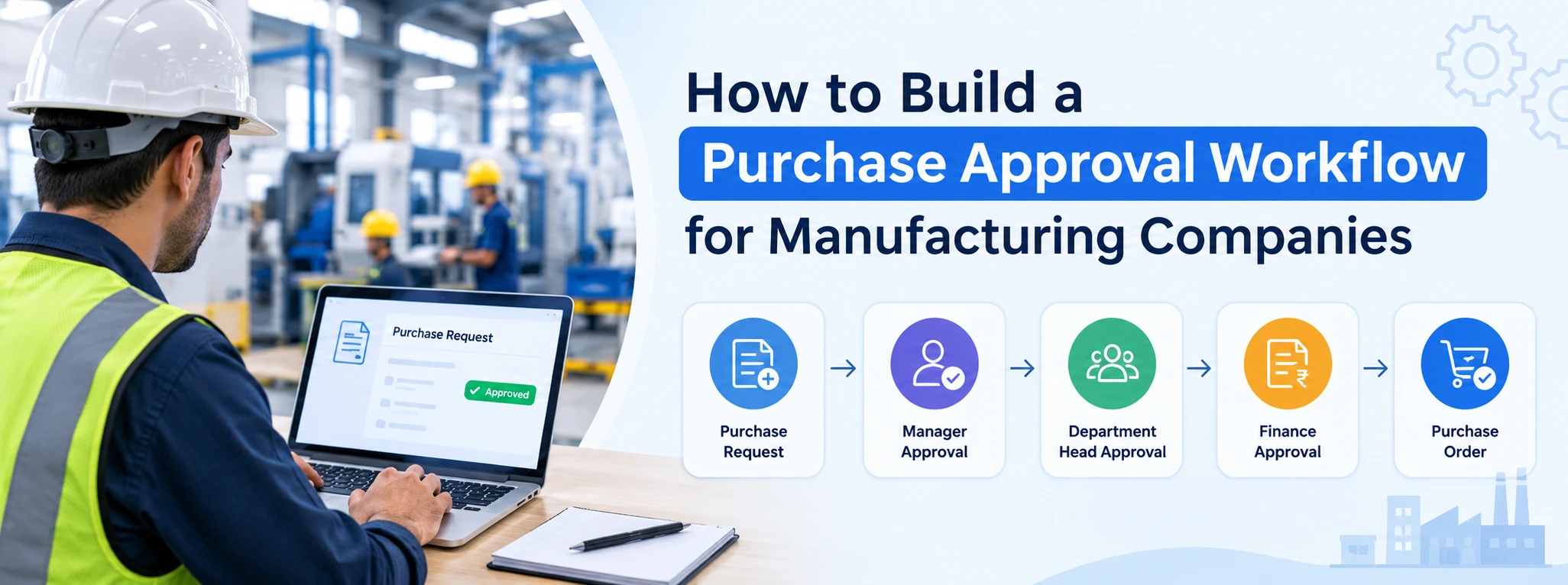
A purchase approval workflow for manufacturing is a structured process that defines how purchase requests are reviewed and approved before spending is authorized. It includes standardized request forms, approval limits, a purchase approval matrix, role-based responsibilities, and urgent-purchase rules. Manufacturers can improve approval efficiency by tracking pending requests, reducing unnecessary approval steps, and using purchase approval software. ZYNO Procurement helps businesses manage purchase requests and organize procurement workflows.
Businesses using ZYNO Books cut accounting time by 70% and stay 100% ZATCA-compliant — automatically.
A purchase approval workflow for manufacturing defines who approves a purchase request, in what order and under which conditions before a company commits to spending. To build one, standardize purchase requests, categorize purchases by value and risk, establish approval limits, assign responsibilities, define an urgent-purchase route and track every decision. The workflow should support purchasing controls without creating unnecessary delays for factory operations.
When a machine needs a replacement part or production requires additional raw materials, purchasing delays can affect day-to-day operations. At the same time, allowing employees to order goods without the right authorization can weaken budget control and purchasing accountability.
A well-designed purchase approval workflow helps manufacturing companies balance these requirements. It establishes clear rules for raw materials, maintenance supplies, production components, services and capital equipment while giving employees a consistent process to follow.
This guide explains how to build a manufacturing purchase approval process, create an approval matrix, handle urgent purchases, measure performance and evaluate purchase approval software.

Simplify purchase requests, organize approval workflows, and improve control over manufacturing procurement with ZYNO Procurement.
A purchase approval workflow is the sequence of steps a purchase request follows from the person identifying a requirement to the person authorized to approve the spending.
It is also called a purchase request approval workflow or purchase requisition approval process.
A clearly defined workflow answers four questions:
In manufacturing, the process can cover raw materials, machine spares, maintenance supplies, production components, tools, services and capital equipment.

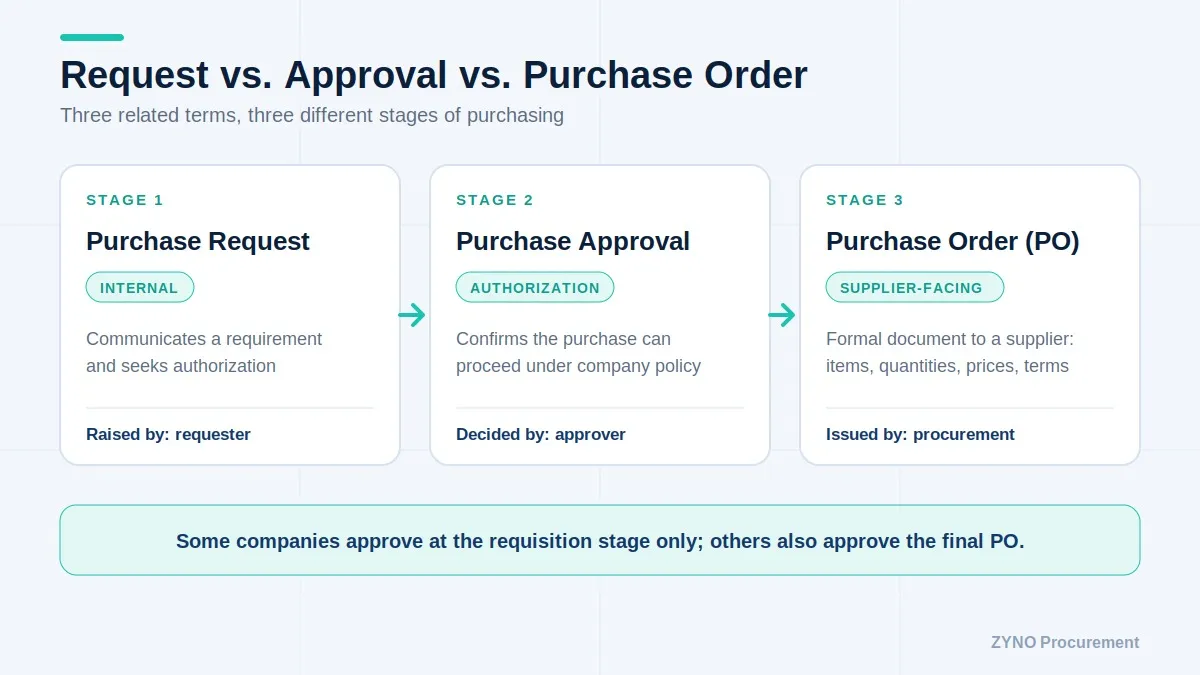
These terms are related, but they describe different stages of purchasing.
| Term | Meaning | Purpose |
|---|---|---|
| Purchase request or purchase requisition | An internal request for goods or services | Communicates a requirement and seeks authorization |
| Purchase approval | Authorization under company policy | Confirms that the purchase can proceed at the relevant stage |
| Purchase order (PO) | A formal purchasing document issued to a supplier | Specifies the agreed items, quantities, prices and terms |
Some manufacturing companies approve a purchase at the requisition stage only. Others also require a separate purchase order approval, particularly when the final order differs from the approved request or when policy requires another authorization.
Document the rule clearly so employees know when approval is required.
For a detailed comparison, read our guide to purchase requisition vs. purchase order.
Manufacturing companies purchase items with different financial values, lead times and operational consequences. A routine consumable and a new production machine should not automatically follow the same approval route.
Without clear rules, five common problems can emerge.
A maintenance team may need a replacement bearing while the production department needs raw materials for an upcoming order. If requests remain in unattended inboxes or pass through unnecessary approval levels, purchasing can be delayed.
A defined workflow identifies the responsible approver and establishes an appropriate route for urgent requirements.
Employees may send every request to senior management because they do not know their approval limits. Alternatively, a purchase may be approved by someone without the required authority.
A purchase approval matrix clarifies who can authorize each type of purchase and when additional approval is necessary.
One department may seek authorization before contacting suppliers, while another places orders first and requests approval afterward.
A common policy establishes consistent control requirements while allowing different approval routes for different purchase categories.
When purchasing decisions are scattered across emails, spreadsheets and messaging platforms, it can be difficult to establish who approved a request, why it was approved or whether its details changed.
A centralized, documented process makes approval decisions easier to review.
A department may appear to have funds available but already have outstanding purchase orders that affect its remaining purchasing capacity.
A defined review process helps the relevant budget owner assess proposed spending and existing commitments according to company policy. Centralized spend visibility makes that review easier.
The goal is not to add more approvals. It is to apply the right controls to each purchase.
Bring purchase requests, approval responsibilities, and purchasing activities into a more organized workflow for your manufacturing business.

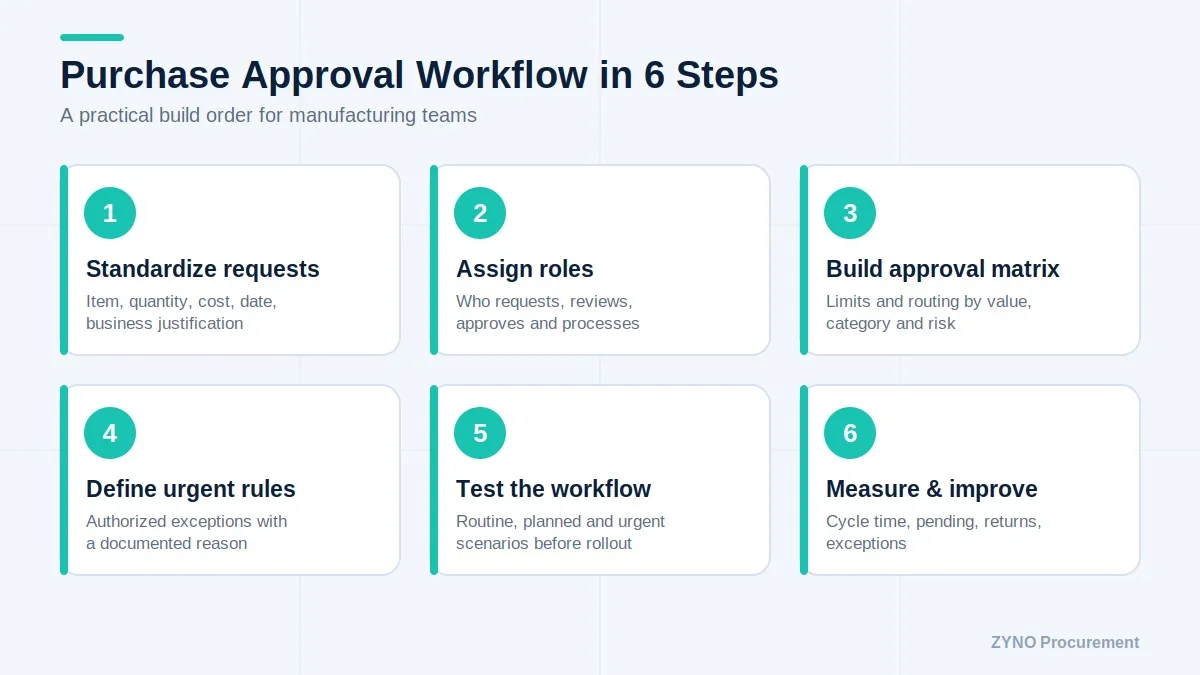
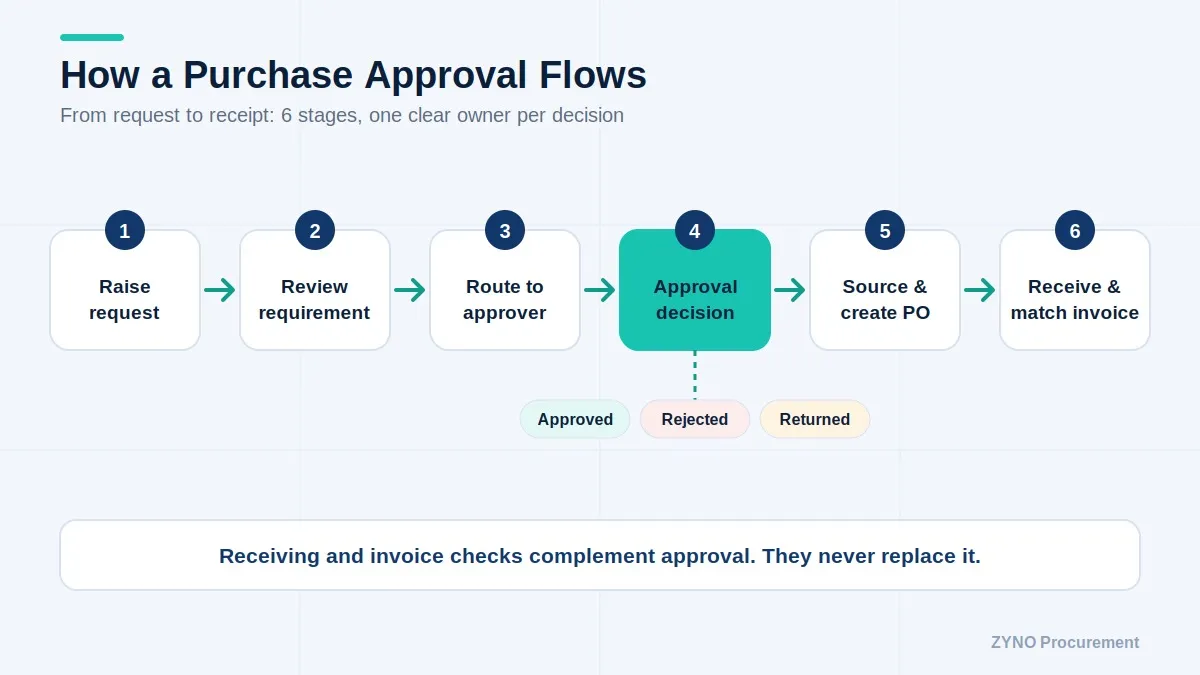
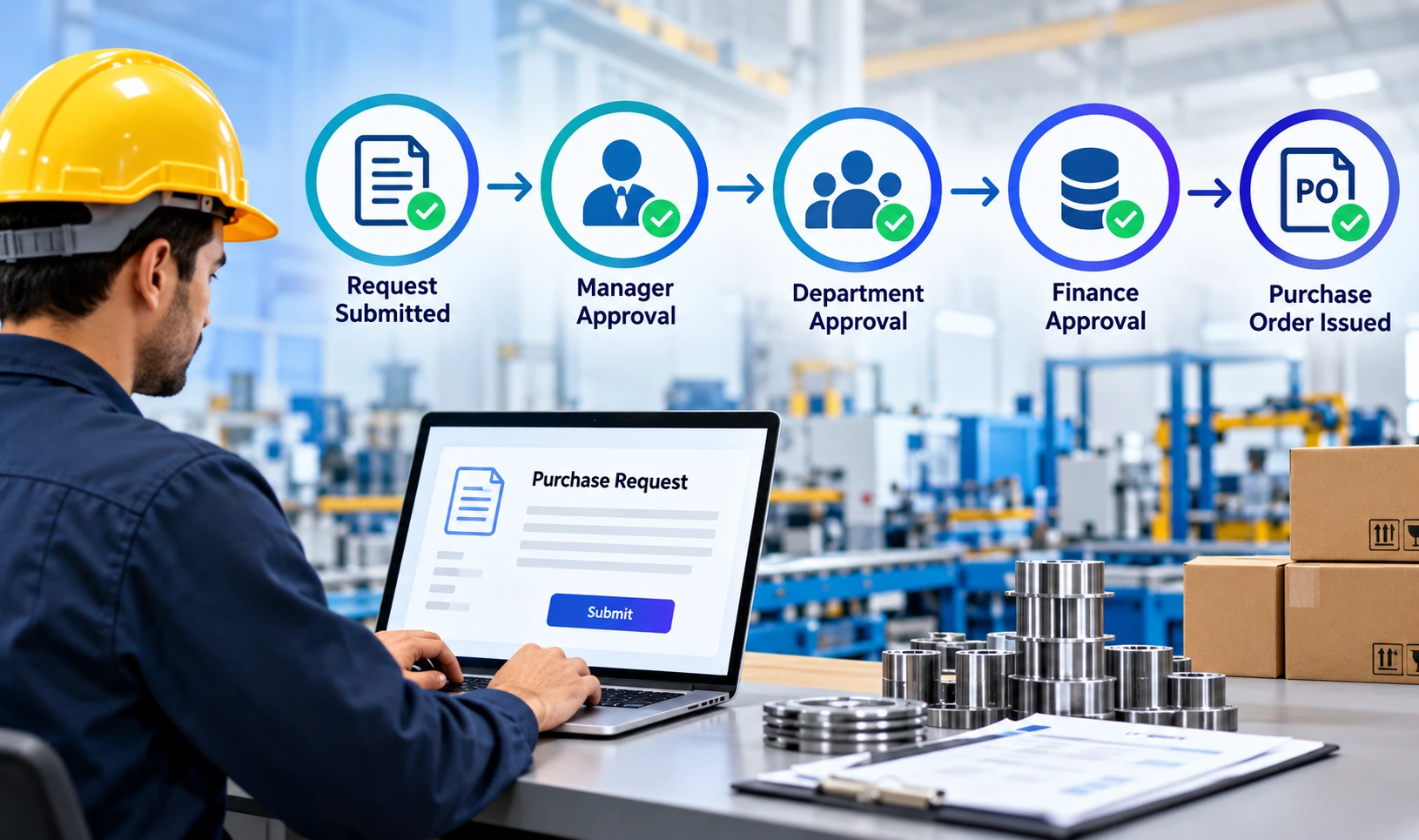
A manufacturing purchase approval process runs from the initial request through review, authorization, sourcing, purchase order creation and receipt. The precise sequence depends on the company's purchasing policy, but responsibilities and approval rules should be clear at every stage.
The requester records what is needed, why it is required and when it is needed.
A purchase request should capture the following information where applicable:
Manufacturing example: A maintenance supervisor requests a replacement bearing. The request identifies the component, quantity, machine, estimated cost and required delivery date.
Standardized request fields help approvers understand the requirement without repeatedly asking for missing information.
The department manager or budget owner checks whether the purchase is necessary, correctly specified and within their area of responsibility.
The review may include:
Budget availability and existing commitments are different considerations. Define who checks them and who can authorize an exception.
If the company expects software to perform automated budget checks, verify that the selected product supports the required functionality.
The request should reach the person authorized to approve that purchase.
Routing criteria may include:
A routine maintenance purchase may need one manager's approval, while capital equipment may require several levels of authorization.
Document the routing rules before configuring them in software.
The authorized approver reviews the request and records a decision.
Define what happens in each situation:
These rules reduce ambiguity and help prevent purchasing commitments from proceeding under unclear authorization.
After the necessary authorization is obtained, procurement follows the company's sourcing and purchasing policy.
This may involve obtaining quotations, comparing supplier offers, reviewing commercial terms and preparing the purchase order.
Some companies source before final approval so decision-makers can evaluate actual supplier prices. Others require approval before sourcing begins. Either approach can work when the policy is clearly defined and the necessary controls are maintained.
Where supported by the purchasing system, an approved requisition can progress into a purchase order without unnecessary re-entry of information.
After delivery, the receiving or warehouse team records the goods received and identifies any discrepancies.
For applicable purchases, finance may compare three records before payment:
This process is commonly known as three-way matching.
Receiving and invoice checks complement purchase approval. They do not replace authorization before the company commits to spending.
See our procure-to-pay process guide for the wider purchasing lifecycle.
Purchase request → Requirement review → Approval decision → Supplier sourcing → Purchase order → Goods receipt and invoice checks
The exact sequence can vary by company policy. The key is to document where approval is required and who owns each decision.
Example: Purchase approval workflow in a factory
Consider four purchasing situations.
| Situation | Illustrative Approval Route | Main Consideration |
|---|---|---|
| A supervisor needs routine shop-floor consumables | Request → Department Manager → Purchasing process | Business need and delegated limit |
| Production needs a planned raw-material batch | Request → Production or Budget Owner → Required Procurement Review → Purchasing process | Production requirement, supplier terms and applicable budget |
| The plant needs a new machine | Request → Department or Plant Leadership → Finance and Other Designated Approvers → Purchasing process | Capital expenditure policy and business case |
| A critical spare is required after a breakdown | Urgent Request → Designated Urgent Approver → Purchasing process → Subsequent review | Operational impact, authorization and documented reason |
These are examples, not mandatory approval routes. Each company should define its own rules based on its structure and purchasing policy.
A purchase approval workflow works best when every participant understands their responsibilities.
| Role | Primary Responsibility |
|---|---|
| Requester | Describes the requirement, quantity, business need and required date. |
| Department or Budget Owner | Validates the need and reviews the request within their authority. |
| Technical or Maintenance Reviewer | Checks technical suitability when required. |
| Procurement Team | Handles sourcing, quotation evaluation and purchase order preparation. |
| Finance or Controller | Reviews financial and policy requirements when applicable. |
| Authorized Approver | Approves, rejects or returns the request within delegated authority. |
| Receiving or Warehouse Team | Records goods received and flags discrepancies. |
In smaller organizations, some responsibilities may be combined. However, higher-risk purchases should have appropriate separation of duties. Where practical, the person requesting a purchase should not be the only person approving it and controlling its payment.
Define these responsibilities before configuring the workflow in software.
A purchase approval matrix defines who can approve each purchase type, which limits apply and what checks are required.
It acts as the rulebook for employees, managers and procurement systems.
The following matrix is illustrative. Actual approval limits and routes should follow the company's financial authority, purchasing procedures and delegation-of-authority policy.
| Purchase Type | Example | Possible Approval Route | Checks Before Approval |
|---|---|---|---|
| Routine Consumables | Gloves and cleaning supplies | Department manager within delegated authority | Business need and applicable budget |
| Maintenance, Repair and Operations (MRO) | Bearings, belts and tools | Maintenance manager, with additional approval when required | Machine impact, urgency and specification |
| Direct Materials | Raw materials and components | Production or department manager plus designated procurement reviewer | Production requirement and supplier terms |
| Project Purchases | Materials for a specific project | Project owner and relevant budget owner | Project requirement and cost allocation |
| Capital Equipment | New machine or plant upgrade | Plant leadership, finance and other designated authorities | Capital expenditure policy and business case |
| Urgent or Breakdown Purchases | Critical replacement spare | Designated urgent-purchase approver | Reason, supporting evidence and subsequent review |
A low-cost component can be operationally critical, while a high-value purchase may already be part of an approved project. Purchase value should therefore be considered alongside category, business risk and company policy.
Review the matrix periodically and whenever organizational responsibilities or purchasing policies change.
Explore ZYNO Procurement's purchase request management.
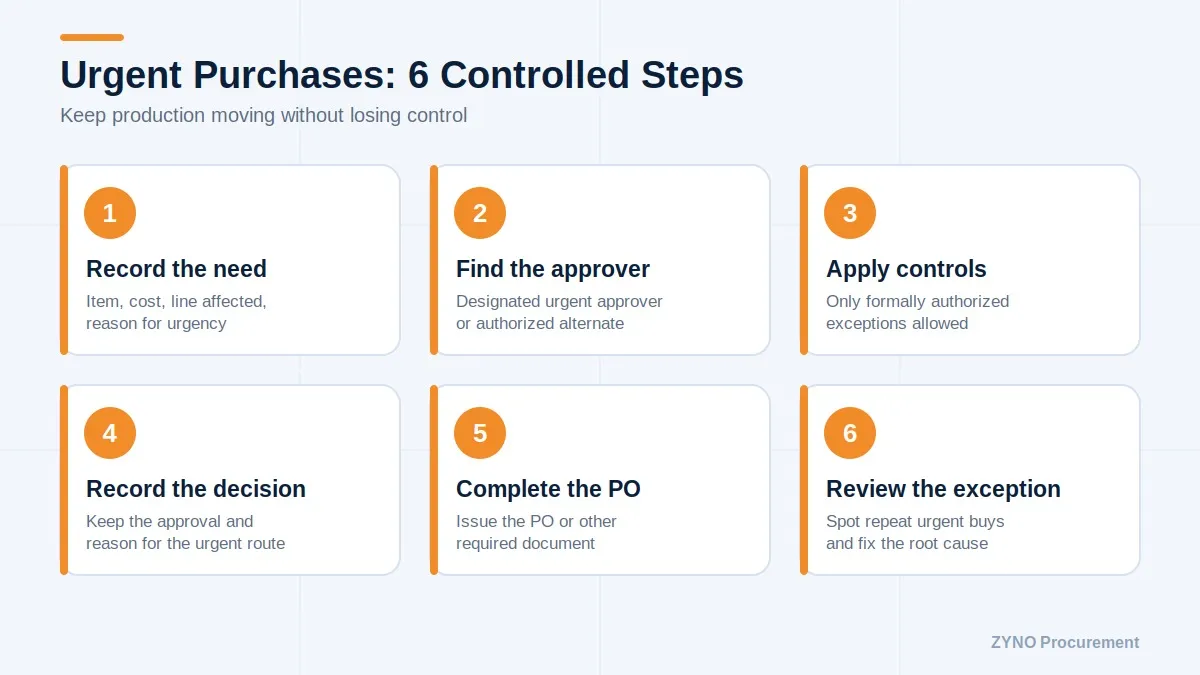
A broken machine may require a replacement component quickly. However, urgency should not mean purchasing controls are ignored.
Manufacturing companies should define a controlled urgent-purchase route before an emergency occurs.
Example: A packaging line stops because a sensor fails. The maintenance supervisor raises an urgent request identifying the machine, estimated cost and operational impact. The designated approver authorizes the purchase under the urgent-purchase policy, and procurement proceeds according to the approved process.
At month-end, the team notices that the same sensor has been purchased urgently several times. This may indicate an inventory or maintenance-planning problem that needs to be addressed.
Do not rely on verbal approvals as the normal way to keep production moving.

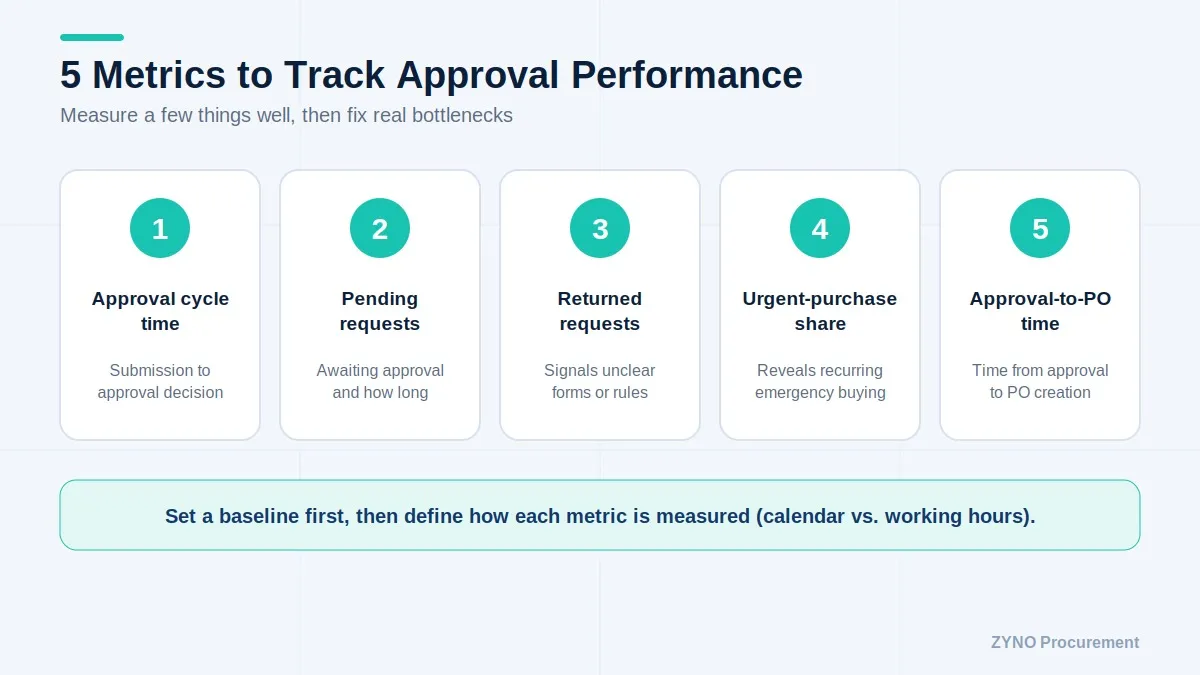
Establish a baseline before making changes. Then track a small number of meaningful measures.
Define how each metric is measured so results remain comparable over time. For example, specify whether approval cycle time uses calendar time or working hours.
Avoid setting one target for every purchase. A routine consumable and a capital equipment purchase require different levels of review.
Use the results to investigate actual bottlenecks, such as incomplete requests, unclear authority, excessive approval levels or unavailable approvers.
Before rolling out a new workflow across the factory, test it against realistic purchasing scenarios.
Use at least three scenarios:
Confirm that each request reaches the correct approver and follows the company's documented policy.
Check what happens when a request is incomplete, rejected, changed after approval or assigned to an unavailable approver. Confirm that delegation follows policy and that the next action is clear.
Test the workflow with one department or plant before expanding it. Ask requesters, approvers and procurement staff to identify unclear fields, unnecessary steps and delays.
Compare approval cycle time, pending requests, returned requests and urgent-purchase frequency against the baseline. Resolve recurring problems before expanding the workflow.
Give a procurement, finance or operations lead responsibility for maintaining approval rules, reviewing exceptions and updating the process when organizational responsibilities change.
The goal is to validate the workflow under day-to-day conditions before making it the standard process across the organization.
Improve purchasing visibility, simplify supplier-related workflows, and manage procurement activities with ZYNO Procurement.
Manual approval processes may work when purchasing volumes are low and responsibilities are straightforward. As the number of requests, departments, suppliers or approval levels increases, managing approvals through email and spreadsheets can become more difficult.
Consider purchase approval software when:
Not every product offers every capability. Test the features that matter to your company instead of relying solely on product descriptions.
Explore ZYNO Procurement to learn more about its procurement offering.
Ask vendors to demonstrate your real purchasing scenarios rather than relying on a generic walkthrough.
| Question to Ask | What to Verify |
|---|---|
| Can approval rules follow our delegation-of-authority policy? | A routine request and a higher-value request taking different routes |
| Can a request require multiple approvers? | A request moving through the required approval levels |
| Can urgent requests follow a defined policy? | The supported exception process |
| Can users see where a request is waiting? | The available request-status view |
| What happens if a request is rejected or changed? | The supported handling and records |
| How does an approved requisition become a PO? | The process from request to purchase order |
| Does the system work with our existing systems? | Confirmed integrations, prerequisites and limitations |
Use a simple evaluation scorecard. For each vendor, record the requirement, the vendor's answer, the evidence demonstrated, any limitations and a score from 1 to 5. Give greater weight to capabilities demonstrated during the session than to unverified promises.
ZYNO Procurement by Elitemindz supports purchase requests, configurable approval rules, multi-level approvals and the conversion of approved requisitions into purchase orders.
Relevant capabilities for evaluating a manufacturing purchase approval workflow include:
The suitability of any procurement platform depends on how its capabilities align with the company's approval policy, organizational structure and existing systems. Confirm the required configuration and integration details during evaluation.
If your team manages requests through email, struggles with unclear approval responsibilities or needs better visibility across departments, a product demonstration can help you assess whether ZYNO Procurement fits your requirements.
Bring one real example of your current approval process and discuss how it could be structured.
It is a defined process for reviewing and authorizing purchase requests before a manufacturing company commits to spending. It specifies who approves a purchase, under which conditions and what happens next.
List the purchase categories, define approval limits for each role, assign responsibilities and establish rules for budget checks, urgent purchases and exceptions. Obtain the required management approval, document the policy and review it periodically.
Purchase requisition approval authorizes an internal request to buy goods or services. Purchase order approval authorizes the formal order under the company's purchasing policy. Some organizations require both stages, while others use a policy-defined process with approval at one stage.
Standardize request information, clarify responsibilities, remove unnecessary approval levels and define authorized delegation. Track pending requests and approval cycle time to identify the actual bottlenecks.
Not by default. Establish an authorized urgent-purchase route, record the reason and decision, apply the controls required by policy and review recurring exceptions.
Some procurement systems support multi-level approvals and configurable rules. Capabilities vary by platform, so test your actual approval scenarios and confirm the required configuration during a demo.
After authorization, procurement follows the company's sourcing policy and prepares the purchase order with the relevant item, quantity, supplier, pricing and delivery details. Where supported, an approved requisition can progress into a purchase order within the system. See how this works in ZYNO's procure-to-pay workflow.
Evaluate configurable rules, multi-level approvals, request status visibility, approval history, request-to-PO continuity, organizational support, usability and integration compatibility. Verify each required capability through a demonstration.
Explore how ZYNO Procurement can help your team manage purchase requests, structure approval workflows, and coordinate purchasing processes.

An effective purchase approval workflow for manufacturing companies combines clear spending authority, complete purchase requests, appropriate approval levels, a controlled urgent-purchase route and documented decisions.
Start by mapping your current process, building an approval matrix and defining rules for exceptions. Test the workflow with realistic scenarios before rolling it out across the organization.
Then evaluate whether procurement software can improve visibility and reduce manual coordination while preserving the controls your company needs.
The goal is not to add more approvals. It is to make the right purchasing decisions easier to authorize, track and review.
Discuss your approval requirements and purchasing workflow with the ZYNO Procurement team.
Procurement Software Trends in 2026: What to Expect
Read More →
Why E-Procurement Outperforms Traditional ERP in Modern Procurement
Read More →
Top Procurement Software in India: 12 Best Options for 2026
Read More →
Best Procurement Software Companies in Kuwait (2025)
Read More →
5 Best Procurement Software in Africa for Enterprises & SMEs (2026 Guide)
Read More →
Best Procurement Software in Nigeria 2026 | Top 5 Picks
Read More →
Best Procurement Software Providers in USA (2025): How AI is Transforming the Future
Read More →
10 Best Procurement Software Providers in Thailand for Streamlined Supply Chain Management
Read More →
Top 10 Cloud-Based Procurement Solutions in Portugal for Businesses in 2025
Read More →
Top 10 Procurement Software Providers in Switzerland 2026: Streamlining Sourcing and Supplier Management
Read More →
What Makes ZYNO Procurement Different from Other Oil & Gas Procurement Software
Read More →
The Digital Transformation of Logistics Procurement in the Middle East
Read More →
A Step by Step Guide to Procurement Management Software for Modern Enterprises
Read More →
Sourcing and Procurement: What is the Difference and Why It Matters
Read More →Difference Between Procurement and Supply Chain Management
Read More →
What Is Procurement Software and Why Do Modern Businesses Need It?
Read More →
Best Procurement Management Software to Automate ERP Process
Read More →
Direct vs Indirect Procurement: Key Differences, Examples & Uses (2026)
Read More →
Smart procurement strategies for cost optimization & risk management
Read More →
What Is Procurement? Everything You Need to Know (Types, Process & SAP)
Read More →Beyond Cost-Cutting: How Procurement Drives Margin Expansion in 2026
Read More →
Direct Procurement: Process, Examples, and When to Use It
Read More →
What Are the 5 Types of E-Procurement? A Complete Guide for Businesses
Read More →
Which Procurement Management Software Is Best? Top Tools Compared for 2026
Read More →
Top 8 Coupa Alternatives to Explore in 2026
Read More →
Looking to Replace Coupa? Discover the Best Alternatives Like ZYNO Procurement
Read More →
How Does Procurement Software Work? A Complete Guide
Read More →
ZYNO Procurement vs Coupa: Best Procurement Software Comparison for Mid-Market Teams
Read More →
10 Best SAP Ariba Alternatives and Competitors in 2026
Read More →
ZYNO Procurement vs SAP Ariba: Which Solution Is More User-Friendly?
Read More →
AI-Powered Procurement Management Software for Fast, Connected, and Visible Workflows in Dubai
Read More →
What is Vendor Management? Complete Guide to Vendor Management Software, Systems, and Processes
Read More →
Best Procurement Management Software In Kenya
Read More →
6 SAP Ariba Alternatives for Mid-Market Businesses in 2026
Read More →
Top E-Procurement Solutions for B2B Organizations (2026)
Read More →
Quotation Format: Free Templates + Complete Guide (2026)
Read More →
Cost Control Software: Features, Benefits & Performance Guide for 2026
Read More →
Procurement Workflow: Steps, Stages, and Real Examples
Read More →
Top 10 Zycus Alternatives for Procurement Teams in 2026
Read More →
Best Precoro Alternative for Purchase Requisition and Procurement
Read More →
Top AI Procurement Tools in 2026
Read More →
Best Tools for Supplier Risk Management
Read More →
FEFO vs FIFO vs LIFO: Differences, Benefits & Which Inventory Method Is Best?
Read More →
AI Procurement Software: Features, Benefits, Use Cases & How to Choose
Read More →
Best AI Tools for Supply Chain Procurement
Read More →
Procurement Risk Management
Read More →
Still Using Excel for Procurement? Read This Before It's Too Late
Read More →
Best RFP Software in 2026: Top Tools Compared for Faster Proposal Responses
Read More →
What Is Procure-to-Pay (P2P)? A Complete Guide
Read More →
Complete Procurement Workflow Guide for Modern Businesses
Read More →
Complete Guide to E-Procurement Solutions for B2B Organizations
Read More →
Cost Control Software Comparison Guide: Features, Pricing & Benefits
Read More →
Purchase Order Tracking: How to Manage Every PO Without the Chaos
Read More →
Inventory Management: What It Is, How It Works and Why It Matters
Read More →
Top 10 Procurement Software Tools for Purchasing Automation in 2026
Read More →
Agentic AI Procurement Platforms and the Future of Strategic Sourcing
Read More →
AI Spend Analytics Software for Procurement Leaders
Read More →
From Prompt to Procurement: How AI Is Transforming Enterprise Purchasing
Read More →
ZYNO Procurement vs IBM Procure-to-Pay Automation
Read More →
ZYNO Procurement vs Infor Nexus: Which Procure-to-Pay Platform Fits Your Team?
Read More →
AI-Powered Procurement Software in 2026: Top 6 Platforms That Actually Deliver ROI
Read More →
Contract Management Software Buyer's Guide: Features, Costs & Top Picks
Read More →
Top 10 Procure to Pay Software Companies in India 2026
Read More →
10 Best Vendor Management Software in India (2026): Features, Benefits & Comparison
Read More →
How Machine Learning and AI Are Transforming Procurement: A Strategic Overview
Read More →
What Is Procurement Software for GP? Features, Benefits and Best Solutions for Businesses
Read More →
What Procurement Software Do Mid-Market Companies Use Instead of SAP Ariba or Coupa?
Read More →
Prompt-Based Procurement Software for Kenyan Businesses
Read More →
Project Management Software: A Complete Guide to Streamline Business Operations and Procurement Processes
Read More →
SAP Ariba vs ZYNO Procurement: Complete Feature Comparison (2026)
Read More →
Coupa vs SAP Ariba vs ZYNO: Which Procurement Platform Wins for Fast-Growing Teams?
Read More →
How AI Procurement Software Is Transforming Purchase Requisition and Supplier Management in 2026
Read More →
Purchase Request Management: A Complete Guide for Modern Procurement Teams
Read More →
The Top 3 Best Practices for Effective Purchase Request Management
Read More →
What Is Purchase Order Automation? How to Automate Purchase Order Processing
Read More →
5 Common Purchase Request Mistakes and How to Avoid Them
Read More →
What is Supplier Relationship Management in Procurement? A Complete Guide
Read More →
What is Strategic Vendor Management? A Complete Guide for Modern Procurement
Read More →
What Are Inventory Control Methods? Complete Guide to Types, Techniques, Systems, & Benefits
Read More →
Inventory Audit Checklist: Steps, Process & Best Practices
Read More →
Warehouse Inventory Management: Best Practices for 2026
Read More →
Treasury Management System (TMS): A Complete Guide for Modern Corporates
Read More →
What is Portfolio Management Services (PMS) and What Are Its Benefits?
Read More →
Generative AI Procurement Software Solution: The Future of Intelligent Procurement
Read More →
Top Contract Management Software Companies in Ethiopia: Features, Benefits & Best Procurement Solutions
Read More →
AI Procurement Software: Complete Guide to Intelligent, Generative AI & Machine Learning Procurement Solutions
Read More →
Top SAP alternatives for small, midsize, and enterprise businesses
Read More →
Best RFP Software in 2026: Top Solutions for Smarter Procurement and Proposal Management
Read More →
GST on Purchase: Complete Guide to GST on Purchases in India
Read More →
Procurement Software in the UAE: How to Choose the Right Solution
Read More →
Supply Chain Procurement: Everything You Need to Know
Read More →
Top 10 Oracle Procurement Alternatives for Businesses in 2026
Read More →
Quotation Software vs Excel: Which Is Better for Businesses in 2026?
Read More →
Contract Management Software Buyer's Guide: Features, Pricing & How to Choose
Read More →
How to Identify the Right Vendor: 10 Simple Steps
Read More →
Top 10 Automated PO Generation Tools in 2026: Best Purchase Order Software with AI Capabilities
Read More →
How to Generate a PO Automatically in SAP: Step-by-Step Guide
Read More →
What Is the Best Budget-Friendly Procurement Software With Vendor Onboarding for Indian SMEs?
Read More →
How to Generate a PO Automatically in SAP: Step-by-Step Guide
Read More →
How to Solve Invoice Mismatches: 10 Real Ways to Fix Invoice Discrepancies
Read More →
Top 10 Vendor Onboarding Tools for Businesses in 2026: Features, Process & How to Choose
Read More →
Vendor Comparison & Supplier Intelligence: How AI Helps Businesses Choose the Right Vendor
Read More →
How to Choose the Right Procurement Management Software in 2026 (Complete Buyer's Guide)
Read More →
How to Reduce Procurement Costs: 18 Practical Strategies That Actually Work
Read More →
How to Choose the Right Procurement Management Software in 2026 (Complete Buyer's Guide)
Read More →
How to Calculate Procurement Software ROI: Formula, Example & Calculator
Read More →
Procurement Software Evaluation Checklist: 35 Criteria for Choosing the Right Platform
Read More →
How Businesses Can Improve Vendor Performance and Manage Supplier Risk
Read More →
Procure-to-Pay Process: Steps, Challenges & How to Automate It
Read More →
Purchase Requisition vs Purchase Order: What’s the Difference?
Read More →
10 Source-to-Pay Software Platforms to Consider in 2026
Read More →
Supplier Management Software Buying Guide: How to Choose the Right Platform
Read More →
Procurement Automation Guide: How It Works, What to Automate & How to Implement It
Read More →
Procurement Software Features: 12 Must-Have Capabilities to Look For
Read More →
Best E-Procurement Software in 2026: Top Electronic Procurement Systems for Modern Businesses
Read More →
AI in Vendor Management: Complete Guide to Automated Supplier Scoring and Supply Chain Risk Analysis
Read More →
Procurement Software vs ERP: What's the Difference and Which Do You Need?
Read More →
How to Reduce P2P Cycle Time: 9 Practical Strategies for Procurement Teams
Read More →
Procurement Software for Oil & Gas Companies in UAE and Saudi Arabia
Read More →
10 Vendor Onboarding Best Practices Every Business Should Follow (2026)
Read More →
10 Contract Clauses Every Business Should Review Before Signing a Supplier Agreement (2026 Checklist)
Read More →
10 Invoice Processing Mistakes That Delay Supplier Payments (and How to Fix Them)
Read More →Source-to-Pay vs Procure-to-Pay: Key Differences, Processes & Software Guide
Read More →
Procurement Challenges: 15 Common Problems & How to Solve Them
Read More →
Supplier Evaluation Criteria: 10 Factors Every Procurement Team Should Assess
Read More →
What Is Strategic Sourcing? Process, Benefits & Best Practices
Read More →
Tail Spend Analysis: How to Identify, Measure and Optimize Fragmented Spend
Read More →
Which Prompt-Based ERP Supports Procurement Automation and Analytics?
Read More →
How to Stop Employees from Making Purchases Without Approval in the UAE
Read More →
How to Build a Purchase Approval Workflow for Manufacturing Companies
Read More →
Best Procurement Software for Sheet Metal Fabrication Companies
Read More →
10 Best Procurement Software for Manufacturing Companies in 2026
Read More →
How to Compare Supplier Quotations and Choose the Right Supplier
Read More →
10 Best Contract Automation Software Tools for 2026
Read More →
Best Procurement Software for CNC Machining Companies: 8 Options Compared
Read More →Partner with ZYNO by Elite Mindz to revolutionize how your business works. Fill out the form, and we’ll reach out with AI-powered solutions made just for you.
We use browser cookies to ensure you get the best experience on our website. Learn more
The form was submitted successfully!